Thursday, October 22, 2009
DDOS: from God with love
neteffect, DDOS: from God with love, 21 Oct 09 "On hearing the news that web-sites of several atheist foundations/NGOs have become victims of severe DDoS attacks, I could only think about one thing: it would be quite hard to blame these attacks on either China or Russia."
Thursday, October 08, 2009
LDS Church and the net
mormontimes.com, LDS Church using the Internet to its advantage, 8 Oct 09 "There are "Mormon Messages" on YouTube, the Mormon Channel streaming online and several sites designed specifically for search engine optimization. Future offerings may include personalized online general conference journals, upgraded ward directories and content for mobile phones."
Friday, October 02, 2009
Scientology
Julian Dibbel, wired.com, The Assclown Offensive: How to Enrage the Church of Scientology, Wired 17:10 background on 4chan and campaigning techniques used against Scientology
Thursday, July 30, 2009
Holy Apps
Guardian,The app economy, 29 Jul 09 discusses several religiously oriented apps for the iPhone, such as iBreviary (longer article in American Magazine on the latter app).
Monday, July 13, 2009
Internet et religion
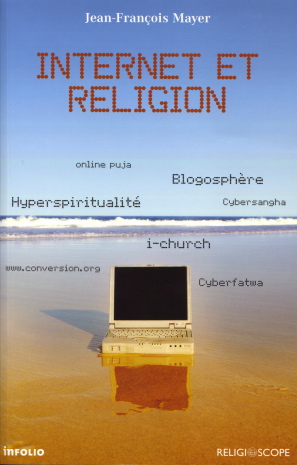
Jean-François Mayer, Livre: Internet et religion - les enjeux d'une mutation technologique (Infolio/Religioscope)
Details on a new book (in French) on the study of religion and the internet. Some specific content in relation to Islam, and some interesting thoughts on how to approach this growing discipline. I would advise students to use this on my Studying Religions on the Internet MA module. Recommended.
Wednesday, June 17, 2009
Virtual Shtetl Portal

AFP, High-tech edge for Poland's Jewish history, 16 Jun 09 "The creators of Poland's future Museum of Polish Jews Tuesday in Warsaw launched the Virtual Shtetl website, a portal they hope will build the museum's collection even before its doors open in 2011.
""This portal has the potential to become the greatest source of information about Jewish life in Poland prior to the war," project creator and coordinator Albert Stankowski told reporters in Warsaw Tuesday."
See Virtual Shtetl Portal
Monday, June 15, 2009
Koogle

Reuters, Orthodox Jews launch "kosher" search engine, 14 Jun 09 "Religiously devout Jews barred by rabbis from surfing the Internet may now "Koogle" it on a new "kosher" search engine, the site manager said on Sunday.
"Yossi Altman said Koogle, a play on the names of a Jewish noodle pudding and the ubiquitous Google, appears to meet the standards of Orthodox rabbis, who restrict use of the Web to ensure followers avoid viewing sexually explicit material."
Lester Haines, The Register, Orthodox Jews tuck into kosher Koogle, 15 Jun 09 "Orthodox Jews - whose religious beliefs have previously kept them a safe distance from the internet - can now avail themselves of a "kosher" search engine, suitably tuned to satisfy even the most demanding rabbi."
Some sections of Koogle appear to still be in development.
Thursday, June 11, 2009
China's computers at hacking risk
BBC News, China's computers at hacking risk, 10 Jun 09 "Every PC in China could be at risk of being taken over by malicious hackers because of flaws in compulsory government software."
Wednesday, June 03, 2009
'Holy Twitter! They're tweeting from the pews'
Diane Mapes, MSNBC, Holy Twitter! They're tweeting from the pews, 2 Jun 09 "Welcome to the 3G(od) network, where social media have become as vital a communication tool for clergy and congregations as the traditional post-sermon coffee hour. While not all churches have gone as far as to incorporate real-time Twitter streams into their Sunday services, many are using Facebook, Flickr, MySpace, LinkedIn and other social networking sites to get the word (or, rather, “the Word”) out there."
Interesting article, with plenty of detail.
Interesting article, with plenty of detail.
Twitter Users Join Psychic Powers Study
Sky News, Twitter Users Join Psychic Powers Study. 1 Jun 09 "The test, conducted by university professor Richard Wiseman, requires Tweeters to correctly guess a location from five photographs."
Monday, June 01, 2009
wired.com, Wikipedia Bans Church of Scientology
wired.com, Wikipedia Bans Church of Scientology, May 29, 2009 "Wikipedia has banned the Church of Scientology from editing any articles. It’s a punishment for repeated and deceptive editing of articles related to the controversial religion. The landmark ruling comes from the inner circle of a site that prides itself on being open and inclusive."
Tuesday, May 19, 2009
Guardian, Seek and ye shall find, 19 May 09
"Ecclesiastical history is not, at first glance, a topic naturally associated with the web. Yet a pioneering web database is taking shape that whizzes church history smartly into the 21st century. The Clergy of the Church of England database (CCEd) aims to provide a constantly updated digital record of the identity and career of every Anglican clergy man in England and Wales over three centuries, from the Reformation to the start of the Victorian age."
Find The Clergy Database here. I thought this was a fascinating article, demonstrating the potential of online resources as a significant tool of study (even though the clergy is not my area!).
Find The Clergy Database here. I thought this was a fascinating article, demonstrating the potential of online resources as a significant tool of study (even though the clergy is not my area!).
Tuesday, May 12, 2009
Facebook removes Holocause denial groups
CNET, Facebook confirms removal of two Holocaust denial groups. Is it enough?, 11 May 09, "Facebook has confirmed my earlier suspicion that it has disabled two of the five Holocaust denial groups whose presence has caused much controversy over the past week, following attorney Brian Cuban's consistent pressure for the groups' removal."
'Jesus Face' iPhone app
CNET, Apple rejects 'Jesus Face' iPhone app, 11 May 09 "An iPhone app called "Me So Holy," that allowed you take a face shot and insert it into a portrait of Jesus or some other religious figure, has been rejected by Apple's tasterati."
When Religion Meets New Media
Currently reading Heidi Campbell, When Religion Meets New Media which contains a range of detailed links on the academic study of religion and the net.
Monday, May 11, 2009
Bible Nano
AFP, Israel president to offer Pope nano Bible, 8 May 09"The Hebrew-language Bible was engraved on a 0.5 square millimetre (0.0008 square inch) chip by scientists from Technion, Israel's Institute of Technology."
Thursday, April 30, 2009
Religious teaching straight to your iPod
USA Today, Religious teaching straight to your iPod, 9 Apr 09 "Evangelists have long used the airwaves to get their messages out to a mass audience. But now, podcast technology is opening the doors to a wider variety of religious teaching than ever before, available on demand and delivered automatically to the computers of a growing number of Americans hungry for spirituality."
Tuesday, April 28, 2009
Facebook CofE
Church of England, Successful youth vocations conference continues on Facebook, 27 Apr 09 "Eighteen would-be priests aged 16 to 19 attending the Church of England’s first specially organised vocations conference for young people in more than 30 years are to continue meeting on Facebook as they listen to their calling. The conference was held at Westcott House and Ridley Hall theological colleges in Cambridge on 17th-19th April, 2009."
Monday, March 30, 2009
Worldwide Faith News, 2010 Religion Communication Congress to Explore Religion Perceptions
"Changes in perceptions about religion, its influence in the public arena and how technology delivers the message are among the issues communicators will consider at Religion Communication Congress 2010."
Also see Religion Communication Congress
Also see Religion Communication Congress
CSM, Cyber spy network with global reach raises alarms, 29 Mar 09
"A group of hackers based almost exclusively in China has hacked into 1,295 computers in 103 countries. Canadian researchers at the University of Toronto revealed that cyber spies infiltrated systems in foreign ministries, embassies, international organizations, and the offices of the Dalai Lama. Thirty percent of the targeted computers could be considered "high-value" targets. No US government computers were compromised; however, the cyber spies broke into a NATO computer for half a day."
Subscribe to:
Posts (Atom)